Radiation Damage
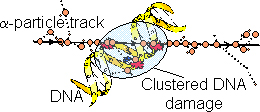
Radiation passing through matter can cause damage. It can cause structural materials to become brittle and break. In humans, it can cause ionisation within cells. The ions produced can take part in chemical reactions interfering in the normal behaviour of the cell. The ionised atoms can cause a molecule to break apart, or alter the molecule so that it no longer performs its normal function, or actually performs a harmful function. If there is sufficient damage, the cell may die.
If the DNA is damaged, the cell may die, but a new one is easily replicated. However, if many cells die, the organism may not be able to recover. If the cells are damaged, they may replicate as damaged cells, which is what cancer is, the spread of defective cells.
If the DNA is damaged, the cell may die, but a new one is easily replicated. However, if many cells die, the organism may not be able to recover. If the cells are damaged, they may replicate as damaged cells, which is what cancer is, the spread of defective cells.
Biological Damage
Biological Damage is often classified depending on where it occurs. The location can have quite different effects, especially if the reproductive organs are involved.
Somatic Damage is cell damage anywhere in the body except the reproductive organs. Somatic damage affects the organism itself, causing cancer, and in high doses, radiation sickness(nausea, loss of hair, fatigue, loss of boy hair) and in very high doses, death.
Genetic damage is damage of the reproductive cells. It doesnt affect the individual, it affects the offspring of the individual, as damage is done to the genes passed on to the offspring, causing mutations, the majority of which are harmful. If the mutations occur in the reproductive organs of the offspring, they may continue to be passed to future generations. The genetic organs are given a much higher weighting when effective dose of radiation is considered.
Somatic Damage is cell damage anywhere in the body except the reproductive organs. Somatic damage affects the organism itself, causing cancer, and in high doses, radiation sickness(nausea, loss of hair, fatigue, loss of boy hair) and in very high doses, death.
Genetic damage is damage of the reproductive cells. It doesnt affect the individual, it affects the offspring of the individual, as damage is done to the genes passed on to the offspring, causing mutations, the majority of which are harmful. If the mutations occur in the reproductive organs of the offspring, they may continue to be passed to future generations. The genetic organs are given a much higher weighting when effective dose of radiation is considered.
